
The 60-second answer
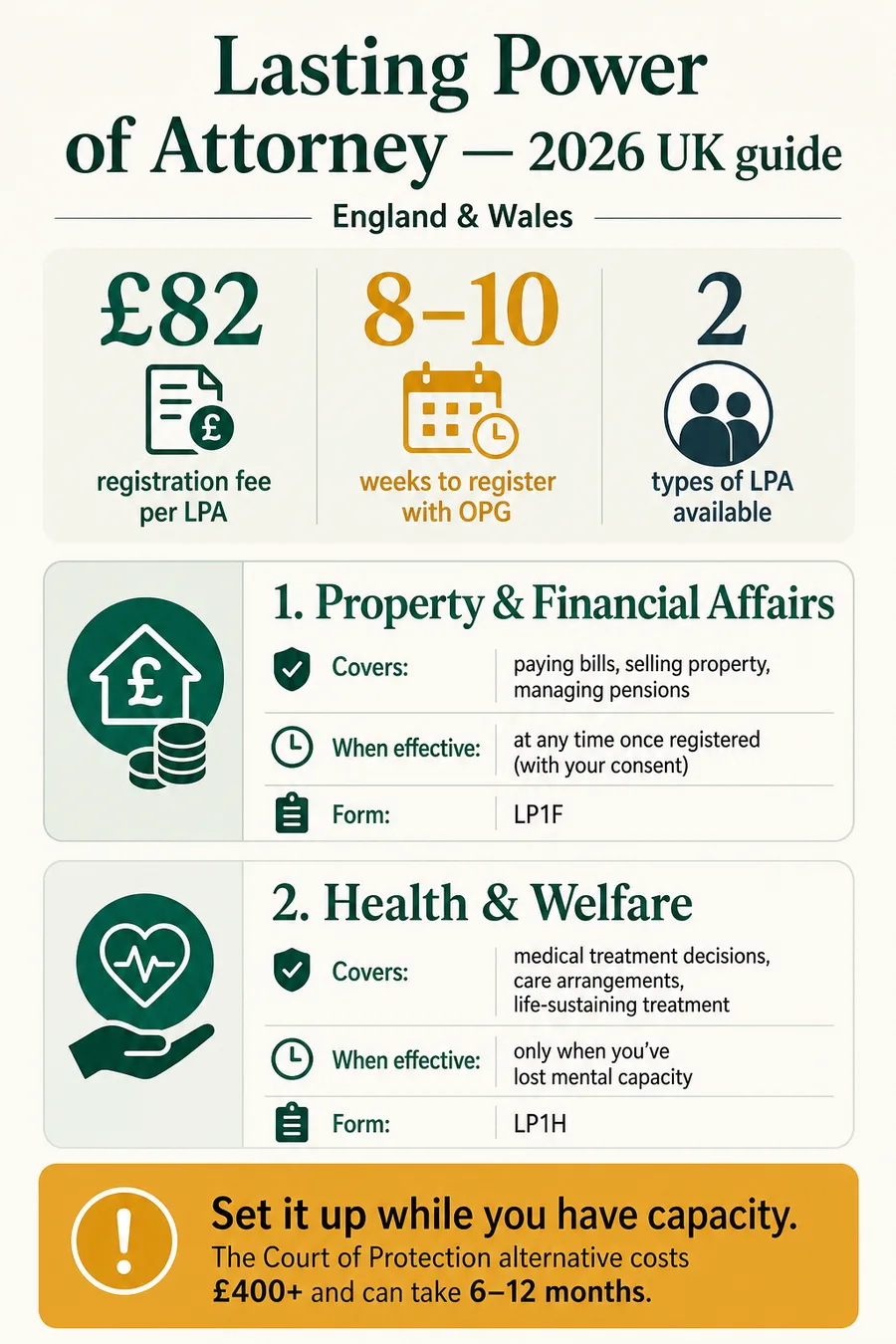
A Lasting Power of Attorney (LPA) is a legal document under the Mental Capacity Act 2005 that lets you (the donor) appoint one or more people (your attorneys) to make decisions on your behalf if you cannot make them yourself. England and Wales recognise two separate LPAs: Property & Financial Affairs and Health & Welfare. They are made on separate forms, attract separate £92 fees, and are registered with the Office of the Public Guardian (OPG).
The single most important thing to understand: you can only make an LPA while you have mental capacity. The moment capacity is lost, the LPA route closes for ever and your family has to apply to the Court of Protection instead - at roughly ten times the cost and twenty times the hassle. Treat the £92 like seatbelt money: trivial when you do not need it, priceless if you ever do. If you are over 60 and you do not yet have both LPAs in place, this is the single most useful thing you will do for your future self this year.
Do you need an LPA? A 30-second triage
Use the branches below to spot which situation you are in. Almost everyone reading this falls into branches 1 or 2 - and the answer is the same: make an LPA today, while it is cheap and easy.
- 1 You are over 18 with full mental capacity and have not made an LPA→ Make both LPAs now - Property & Financial Affairs and Health & Welfare. The £184 fee covers a decision-making safety net for the rest of your life. The cheapest insurance you will ever buy.
- 2 You are a couple - only one of you has an LPA→ Make a matching pair. If both partners lose capacity (a stroke and a fall in the same year is not unusual), one LPA does not cover the other partner. Most couples make four LPAs in total - £368 all in.
- 3 You have an Enduring Power of Attorney (EPA) from before October 2007→ Your EPA still works for property and finance but does NOT cover health and welfare. Make a Health & Welfare LPA to fill the gap - and register the EPA the moment capacity starts to fail.
- 4 A parent or partner is showing early signs of dementia→ Move fast. Capacity is decision-specific, not all-or-nothing - most early-stage dementia patients still have capacity to grant an LPA. Get a GP to confirm capacity and use a solicitor or doctor as certificate provider for extra evidential weight.
- 5 A relative has already lost capacity with no LPA in place→ The LPA route is closed. You will need to apply to the Court of Protection for a deputyship order - budget six months, £432 application fee, ~£500/year ongoing supervision and bond. See section below.
If you are already helping an older parent with bills, banking and benefits, the LPA sits alongside the practical steps in our helping elderly parents with money guide - the LPA is the legal backbone, the banking and benefits checks are the day-to-day plumbing.
The two LPA types compared
Most people need both. They cover different decisions, take effect at different times, and have different rules about who can use them. Do not assume one covers the other - they do not.
| Feature | Property & Financial Affairs | Health & Welfare |
|---|---|---|
| Form code | LP1F | LP1H |
| OPG fee | £92 (2026) | £92 (2026) |
| When it can be used | As soon as registered (with donor's permission) OR only after loss of capacity - donor chooses | ONLY after donor lacks capacity for that specific decision. Hard legal rule. |
| What it covers | Bank accounts, paying bills, HMRC dealings, pensions, investments, selling or letting property, running a business | Medical treatment, care home choice, day-to-day care, diet, daily routine, who you have contact with - and (if ticked) life-sustaining treatment |
| Joint accounts | Banks will freeze a joint account on incapacity without an LPA. With one, the attorney can keep it running. | Not applicable. |
| Care-home decisions | Pays the fees, sells assets to fund them. | Decides WHICH care home and what care is given. |
| Key safeguards | Attorneys must keep accounts; gifts limited to "reasonable occasion" amounts; conflict of interest restrictions. | Best-interests test under the Mental Capacity Act; life-sustaining-treatment box must be deliberately ticked. |
| Who can use it | Banks, HMRC, conveyancers, pension providers, DWP. | Doctors, hospitals, care homes, social workers. |
| Do you need it? | Yes - for almost everyone | Yes - especially over 60 or with a diagnosis |
What an LPA costs in 2026
The OPG fee in England and Wales rose to £92 per LPA on 17 November 2025 and has not changed for 2026. For most people the maths is brutally simple:
- One LPA (just one type): £92
- Both LPAs for one person: £184
- A couple making both LPAs each (four LPAs in total): £368
There are two fee-remission routes if cost is a barrier. 50% remission (so £46 per LPA) applies if your gross annual income is below £12,000 - proven with last year's tax return, payslips or a benefits letter. 100% exemption (free) applies if you receive certain means-tested benefits including Income Support, income-based JSA or ESA, Housing Benefit, Working Tax Credit (with a disability element) or the Guarantee Credit part of Pension Credit. The exemption is requested using form LPA120, submitted with the LPA itself.
Solicitor-drafted LPAs are an extra £300-£600 per LPA on top of the OPG fee. For straightforward family situations this is rarely worth paying for - the GOV.UK online service walks you through every decision and catches most rejections. Pay a solicitor when: there is a family business, a blended family with stepchildren, a vulnerable beneficiary trust, an estate over £2m, an attorney living abroad, or any history of family disputes. Otherwise, the GOV.UK route is the standard recommendation.
How to set up an LPA - the 7-step process
The application process is structured but unforgiving - sign in the wrong order and the OPG will reject and refund. The seven steps below are the order the form actually moves through.
- Choose your attorneys. 1-4 people, aged 18+, with their own capacity. For Property & Financial they must not be bankrupt. Name at least one replacement attorney in case an original cannot act.
- Decide how they act together. Either "jointly" (every decision needs everyone's signature - safer but fragile) or "jointly and severally" (any one of them can act alone - almost always more practical). A hybrid is possible but invites trouble.
- Choose a certificate provider. Someone who has known you personally for at least two years, OR a professional (solicitor, GP, registered nurse, social worker). They sign to confirm you understand what you are signing and are not under pressure. They cannot be a family member, your attorney, or related to one.
- Complete the form. On gov.uk/power-of-attorney using the "Make a Lasting Power of Attorney" service. The form asks about restrictions, preferences, life-sustaining treatment (Health LPA only) and "people to be told".
- Sign in the legal order. Donor first, then certificate provider on the same or later date, then each attorney. Reverse this order and the OPG rejects. Wet-ink signatures only; electronic signatures are not yet permitted for LPAs.
- Wait the statutory 4 weeks if you have named "people to be told". They have that window to raise concerns with the OPG.
- Send to the OPG with the £92 fee. Post or upload. Registration takes 8-10 weeks. The OPG returns a stamped LPA; only then can it be used.
Your LPA application checklist
Tick each step as you complete it. The bar fills as you progress - both LPAs share these seven steps so use the same checklist twice if you are making both.
Work through each step in order. Tick as you go.
Choosing your attorneys
An attorney has wide-ranging power over your money or your medical care. The wrong choice is the single biggest risk in the LPA process - far bigger than the £92 fee or the OPG paperwork. Four practical filters:
- Trust comes first. Attorneys do not need to be financial experts; they need to be honest, available and willing to ask for help. A trusted spouse plus one adult child (jointly and severally) is the most common UK choice.
- Geography matters. An attorney who lives 200 miles away can still act on a Property LPA but will struggle with day-to-day Health & Welfare decisions. Consider naming a local relative as the primary Health attorney.
- Always name a replacement. If your only attorney dies, loses capacity or refuses to act, an LPA with no replacement collapses and the family is back to the Court of Protection. A named replacement steps in automatically.
- Avoid putting a "joint only" structure on the form unless you really mean it. Jointly means every signature for every transaction. Cancelling a Netflix subscription requires every attorney's authority. Jointly and severally is right for almost everyone.
The most common LPA mistakes
- Signing out of order. Must be donor → certificate provider → attorneys. The certificate provider cannot sign before the donor. Each attorney must sign after the certificate provider. Date the boxes carefully.
- Mixing up restrictions and preferences. "My attorneys must consult my children" written as a restriction is rejected - it is unenforceable. Put it under preferences. A restriction must be a thing an attorney can either definitely do or definitely not do.
- Using a disqualified certificate provider. Family members, anyone living with you, your attorneys, or anyone related to your attorneys cannot certify. Choose a friend who has known you 2+ years OR a regulated professional.
- Forgetting to register. A signed-but-unregistered LPA has no legal force. The OPG must register it before your attorneys can act. Register it now, not when you need it - registration cannot be done by anyone other than the donor or attorneys, and attorneys can only register if you (the donor) still have capacity to authorise it OR have lost it.
- Bankrupt attorney on a Property LPA. Bankruptcy automatically removes a Property attorney. Check the Insolvency Register before naming someone - and name a replacement just in case.
The Mental Capacity Act 2005 test for capacity
The Act sets out five statutory principles: (1) a person must be assumed to have capacity unless proved otherwise; (2) all practicable steps must be taken to help them decide before declaring them incapable; (3) an unwise decision is not the same as incapacity; (4) any decision made on their behalf must be in their best interests; (5) it must be the least restrictive option. The capacity test itself asks whether the person can understand the relevant information, retain it long enough to decide, weigh it as part of the decision, and communicate the decision (by any means). Capacity is decision-specific - having dementia does not automatically remove the capacity to grant an LPA. Most early-stage dementia patients can still validly make an LPA; the certificate provider's job on the form is to confirm that capacity exists at the moment of signing.
What if there is no LPA? The Court of Protection route
If a relative loses capacity without an LPA in place, the family cannot just take over. Banks freeze accounts. The DWP appoints a "benefit appointee" but only for benefit income. To make any other decision someone has to apply to the Court of Protection for a deputyship order. This is the worst-case path the LPA is designed to avoid.
The 2026 cost picture for a property-and-affairs deputyship:
- Application fee: £432
- New deputy assessment fee: £100 (first-time deputies)
- Annual OPG supervision fee: £320 (general) or £35 (minimal, for smaller estates)
- Security bond: typically £350/year, scaling with estate size
- Solicitor fees if used: £950-£1,500 fixed fee is common for the application itself
- Time to obtain order: typically 6 months (range 4-9); urgent cases can be expedited
The deputy must keep detailed accounts and file an annual report (form OPG102). They cannot make gifts of any significance without separate court permission, cannot make a will for the incapacitated person, and cannot make life-sustaining-treatment decisions (those go to a separate Health & Welfare application, which the court rarely grants). A Health & Welfare deputyship is granted only in exceptional circumstances - courts strongly prefer case-by-case best-interests decisions for medical matters.
The single most stressful element families report is not the money. It is the four-to-nine month gap during which the unsold house cannot be sold, the care home demands payment that no one is authorised to release, and the bank refuses to discuss anything. The £92 LPA fee is insignificant beside this.
Scotland, Northern Ireland and the rest of the UK
Scotland operates under the Adults with Incapacity (Scotland) Act 2000. Equivalents are the Continuing Power of Attorney (financial) and Welfare Power of Attorney (health and care). Both can be combined in one document. Registration is with the Office of the Public Guardian (Scotland) at £87 per document with fee exemptions for low-income applicants.
Northern Ireland is in transition. The long-standing Enduring Power of Attorney (EPA) framework has been gradually replaced under the Mental Capacity Act (Northern Ireland) 2016, which introduces a Lasting Power of Attorney equivalent. Implementation is still being phased in by the Department of Health through 2025-26 - check the latest position with the Office of Care and Protection before making one.
An English LPA does not automatically work in Scotland or Northern Ireland. It can be applied to the Scottish Public Guardian for recognition, but most retirees who move across borders simply make a fresh local document. If you split your time between nations, make matching documents in each.
Three real situations
Situation: Both partners are healthy and active. They have a will but no LPAs. Their adult son lives in Manchester; their daughter is in Singapore.
They use the GOV.UK online service over a weekend and make four LPAs in total - Property and Health LPAs for each partner. They name each other as primary attorneys (jointly and severally) and their UK-based son as the replacement attorney on all four. Total cost: £368. Total time: about three hours of paperwork plus the OPG's 8-10 week processing wait. The LPAs are filed in a fireproof box; each partner gives a certified copy to their GP and bank.
Six years later, Mrs Patel has a stroke. Her husband can immediately pay the rehab clinic, manage her pension drawdown and arrange home adaptations. No legal vacuum, no Court of Protection. The £184 spent in 2026 is the highest-return money they ever spent.
Situation: George has been forgetting names for two years. The GP has just confirmed early-stage Alzheimer's. He has no LPA. His daughter Helen is panicking.
Capacity is decision-specific, and George still has capacity to grant an LPA - the GP confirms this in writing. The family acts quickly: a local solicitor drafts both LPAs and acts as the certificate provider (because of the diagnosis, a professional certificate provider carries more evidential weight if the LPA is ever challenged). Total solicitor cost around £900 plus £184 OPG fees.
Eighteen months later, George moves into a care home. Helen, acting as attorney, sells the house to fund the care, negotiates the fees and handles the local authority financial assessment. The Health & Welfare LPA gives her the legal standing to argue successfully against an unsuitable care plan. The early move was the right call: by 2028 George could not validly grant an LPA at all, and the Court of Protection route would have eaten six months and £1,500.
Situation: James suffered a major stroke on a Tuesday morning. He is alive but cannot speak or write. He had always meant to 'sort out an LPA' but never did. His wife and two sons must now manage everything.
The LPA route is closed - James no longer has capacity to grant one. His wife applies to the Court of Protection for a property-and-affairs deputyship. The process takes seven months; during that time the joint mortgage account is frozen, a planned house sale falls through, and the family covers the £4,400/month nursing-home fees from their own savings while waiting for the court order.
Final cost of the deputyship: £432 application fee, £100 assessment fee, £950 solicitor fee for the application, £350 first-year security bond and £320 annual supervision fee - a touch over £2,100 in the first year, then £670/year for as long as the deputyship runs. Plus the seven-month gap. The contrast with the £92 LPA fee, paid in advance, could not be starker. The takeaway from every solicitor we spoke to was the same one line: "If we could rewind time, the only thing we would change is making the LPA five years earlier."
LPA questions, answered
- How much does a Lasting Power of Attorney cost in the UK in 2026?
- The Office of the Public Guardian charges £92 to register each LPA in England and Wales, up from £82 on 17 November 2025. A single person making both types costs £184. A couple making both LPAs each spends £368. If your gross annual income is below £12,000 you pay half (£46 per LPA); if you receive certain means-tested benefits such as Income Support, income-based JSA/ESA, Housing Benefit, Working Tax Credit or Guarantee Pension Credit you pay nothing. Solicitor-drafted LPAs typically add £300-£600 per LPA, but most people draft their own on GOV.UK and only pay the £92 OPG fee. In Scotland the registration fee for a Continuing or Welfare Power of Attorney is £87 to the Office of the Public Guardian (Scotland), again with remission for low-income applicants.
- How long does it take to register an LPA with the Office of the Public Guardian?
- The OPG quotes 20 weeks as its statutory service standard but the actual median in early 2026 is 8-10 weeks once your fully-signed form arrives. The clock includes a mandatory 4-week waiting period during which anyone named on the form can object. The OPG cleared its post-COVID backlog through 2024-25, helped by the new online "Make a Lasting Power of Attorney" service that went fully live in November 2024 under the Powers of Attorney Act 2023. Paper applications take roughly the same time as online ones today. Plan ahead: the LPA only becomes useable once the OPG returns it stamped - a partial or unregistered LPA cannot be used by your attorneys.
- What are the two types of LPA and when does each take effect?
- A Property & Financial Affairs LPA covers bank accounts, paying bills, dealing with HMRC, selling investments and selling property. You can opt to let it be used as soon as it is registered (with your permission) or only after you lose capacity - most people choose "as soon as registered" because it allows attorneys to help with online banking or arrange a property sale during a hospital stay. A Health & Welfare LPA covers medical treatment decisions, care home choice, day-to-day care and (if you tick the box) life-sustaining treatment. It can ONLY be used after you lose the capacity to make the decision in question - that is a hard legal rule under the Mental Capacity Act 2005.
- What happens if you lose capacity without an LPA?
- Your family cannot simply take over. Banks freeze joint accounts where the incapacitated person is a signatory. The DWP will pay benefits into a nominated appointee account but will not give the appointee access to the rest of the person's money. To make broader financial or welfare decisions someone - usually a close relative - must apply to the Court of Protection for a deputyship order. The court application fee is £432, an assessment may add £100, the appointed deputy normally has to pay for an annual security bond (typically £100-£500 depending on the estate size) and pays an annual OPG supervision fee of £320 (general supervision) or £35 (minimal supervision). Timescales range from four to nine months, and the deputy must file detailed annual accounts. The whole process typically costs £1,000-£1,500 in the first year and £400-£600 a year thereafter. An £92 LPA avoids all of this.
- Who can be my attorney?
- Anyone aged 18 or over with their own mental capacity. They do not have to be a UK resident. Most people choose a spouse or partner plus one or two adult children, with at least one replacement attorney named in case an original attorney dies, loses capacity themselves, or simply does not want the role any more. For property and finance, the attorney must not be bankrupt or subject to a Debt Relief Order - bankruptcy automatically revokes their authority on that LPA. You can appoint up to four attorneys and you must decide whether they act "jointly" (every decision needs every attorney's signature - safer but slow and fragile if one is unreachable) or "jointly and severally" (any one of them can act alone - far more practical). A hybrid "jointly for some decisions, severally for others" is allowed but tends to create disputes; most solicitors recommend straight jointly-and-severally.
- What is the difference between a restriction and a preference on an LPA?
- This single distinction causes more rejected LPAs than any other mistake. A PREFERENCE is guidance - "I would prefer to be cared for at home". Your attorneys must consider it but they do not have to follow it. A RESTRICTION is a legal limit - "My attorneys must NOT sell my house at less than market value" or "My attorneys must NOT make gifts above £500 per recipient per birthday". Restrictions are legally binding and the OPG will reject the LPA if the restriction is contradictory, impossible, or attempts to do something an attorney cannot legally do anyway. The classic rejection is writing "My attorney must consult my children before any decision" as a restriction - the OPG treats that as a preference and warns you. If in doubt, file under preferences. You can also add "instructions" (binding) and "guidance" (advisory) elsewhere on the form; the OPG's most-rejected list almost always centres on conflicting instructions.
- Can I make an LPA online?
- Yes. Since November 2024 the GOV.UK service "Make a Lasting Power of Attorney" supports a full digital journey from drafting through identity verification to OPG submission. You still need wet-ink signatures from the donor, the certificate provider and every attorney in the right order - the form is printed for signing then re-uploaded - but the online service catches the common errors (signing out of order, missing certificate provider, unclear restrictions) that previously caused tens of thousands of rejections. Online applications are processed in the same queue as paper today, so the speed advantage is in fewer rejections rather than faster turnaround.
- What is the Mental Capacity Act 2005 test for capacity?
- The Act lays down five statutory principles (a person is assumed to have capacity unless proved otherwise; you must give all practicable help to support decision-making; an unwise decision is not the same as incapacity; any decision made on someone's behalf must be in their best interests; and it must be the least restrictive option). The capacity test itself has two stages. Stage one: does the person have an impairment of, or disturbance in, the functioning of mind or brain? Stage two: does that impairment mean they are unable to make THIS specific decision at THIS specific time? Inability is defined as failing any one of: understand the relevant information; retain it long enough to decide; weigh it up as part of the process; or communicate the decision (by any means). Capacity is decision-specific - someone may have capacity to choose what to wear but not capacity to manage £400,000 of investments. A GP or solicitor can carry out the assessment for an LPA; the certificate provider on the form confirms it at the point of signing.
- Does my LPA work in Scotland or Northern Ireland?
- No - and this catches retirees who move. Scotland has its own framework under the Adults with Incapacity (Scotland) Act 2000: Continuing Powers of Attorney (financial) and Welfare Powers of Attorney, registered with the Office of the Public Guardian (Scotland) for £87 each. An English LPA is not automatically recognised in Scotland - you can apply to the Scottish OPG for recognition but most people make a fresh Scottish PoA. Northern Ireland is in transition: the long-standing Enduring Power of Attorney is being replaced under the Mental Capacity Act (Northern Ireland) 2016, with the new Lasting Power of Attorney provisions still being phased in by the Department of Health through 2025-26. If you move across UK borders for retirement, take fresh local advice - assume the LPA you made does not travel.
- Can I cancel or change my LPA after registration?
- Yes, provided you still have capacity. To revoke an LPA you sign a Deed of Revocation (a free template is on GOV.UK) and send it to the OPG along with the original LPA document. The OPG removes the LPA from its register and notifies your attorneys. You can also remove a single attorney and keep the others, but you cannot add a new attorney - that requires making a fresh LPA. If you have already lost capacity the LPA cannot be revoked by you, but the Court of Protection can revoke it if an attorney is acting against your best interests. The OPG has a free safeguarding investigation line (0300 456 0300) and a duty to investigate any complaint about an attorney's behaviour. In 2024-25 the OPG investigated more than 3,000 cases and removed several hundred attorneys.
This page covers the LPA as part of a wider retirement plan. For the step-by-step detail, see our dedicated guides: lasting power of attorney explained, how to set one up yourself, what it costs and how to pay nothing, and what to do if capacity has already been lost.
For what happens after a death, see our probate, wills and power of attorney hub - including when probate is actually needed and the probate cost calculator.
Figures verified on 23 July 2026. The £92 LPA fee has applied since 17 November 2025, having risen from £82. Court of Protection fees were updated on 21 July 2026 - the application fee is now £432. Always confirm current fees on GOV.UK before applying.